Barradale Farm: building a homestead

Showing posts with label building a homestead. Show all posts

In the quiet of the night

A short poem on the never-ending nature of motherhood, and the quiet moments in between.


Stars pierce the night sky

and a cloak of darkness wraps  

itself around the little house.


Inside, the wood fire crackles

warming her family through the night.

Children sleep soundly 

under bundles of blankets

their sweet faces at peace.


Echos of arguments, laughter and love 

reverberate through the bones of the home.

The old kitchen table bathed in a soft glow of light

as she sets the kitchen to rights,

her body weary but her heart full.


Ready to do it all again

tomorrow.

3

Well hello there! 2025

Well, hello there! I hope you have had a very Merry Christmas and a Happy New Year!
 

I must have started at least half a dozen posts since I last updated you here, but I didn't manage to finish any of them. I guess my heart was not quite in it. I feel like in many ways, our life here is not what we imagined when we moved here 6 years ago. We had hoped that by now, we would be beginning to consider building our home on the north-facing hill, that we would have basic boundary fencing up, and that we would be well on our way with livestock. 


However, as many of you well know and have experienced for yourselves, the last 5 or 6 years have not been easy in this economy. The cost of everything has gone through the roof and in turn our progress has been painfully slow. 


18 months ago, I felt the pull to finish up my theology study, which I started years ago before I became chronically unwell with a heart condition. Thankfully, I am well now, and I have gone on to do a full Bachelor of Theology. I have 11 subjects left and am studying half-time. I am also working part-time as a lay minister in the Anglican church with children and families. It is a wonderful job, which I love, and I work with the very best people. 


This has, however, been a big adjustment for our family. It's a significant increase in travel and time spent off the farm, and it takes up a huge amount of my week. Financially, although the pay for a lay minister is very modest, it does help to cover the ever-increasing bills. However there is always a cost in working, too. Petrol and childcare are significant expenses. I am not entirely sure what this will look like in 2025, how big a study load I will juggle or what subjects I will do. There seem to be two pathways regarding work and study appearing, and I am contemplating which one I am called to be on. 


The pressure of travel has not been easy, and at times, we have questioned whether it is wise to stay on the farm. The world feels so different now than it did six years ago—harder. We have, at times, felt less hope that we will ever be able to get this place up and running properly. As such, we have questioned if it is worth investing the kind of money and time it will require. Our children are only young once, after all. 


But as I watch our dairy goats snooze in the afternoon sun, hear the cackle of the chooks, and see the fairy-wrens darting around the bushes, we continue to hold to our dream. Though it is perhaps a little more battered these days and it has changed over the years. It has simplified. There is no end date nor percentage of our own food we hope to grow and preserve. The reality is Grant works full-time off-farm and I, too, work a significant amount of time off-farm now. Caring for a family of 6 is a big job in itself. Our goal is simply to live well, grow and raise some of our own food, to enjoy our family and live within our means. 


We have recently started the extension on the yurt. To see the deck come together has injected a spirit of hope and excitement once again into our hearts. Friends and family have come to lend a hand, and their help and encouragement means a lot. There is a few more hours of work to do, and then we will be able to lay the yellow tongue flooring and the first stage of the build will be complete.  


There is a gap between the new deck and the build, but don't worry. They will be joined by stairs going down to the garden and a landing, which will double as a small outdoor sitting nook. 


The children are doing well, William is driving now, he has bought himself a project car which he is enjoying a lot, and he is entering year 12 this year. Angus is entering year 8, learning guitar and has a lovely group of friends, Henry is in his final year of primary school doing year 6 and is as funny and interesting as ever, and sweet little Elsie continues in her family daycare. She is 5 in February - oh, how time flies!  She will go to big school in 2026. 


Though there is more to share, I might leave that for another time. I am not even sure anyone will find this post as it has been so long between updates! Like many things, this blog seems to be in a transition period aswell, and I have wondered what I should do with this space. To continue? To let it go? To let it evolve into something new? 


Perhaps that, too, will become clear in time. 


Much love and blessings to you and yours. 

- Em xx

38

reflections and looking forward

Happy New Year dear readers, may 2024 bring much beauty, peace, love and good health to us all. 

2023 was a mixed bag for most of us I think. On one hand, we found new friendships and community which has brought immense beauty and joy. I did a permaculture course and returned to theological study. Both of which built my confidence and helped me find direction as I entered a new decade of life. We spent a lot of time developing the garden, got a milking goat and continued to make small progress on the farm. Our family continues to grow and the children are all doing well. William enters year 11 this year and will be moving to an excellent trade school, Angus starts high school, Henry is in year 5 and Elsie has just started a lovely family daycare one day a week while I attend lectures. 


On the other hand, we have watched wars erupt and continue across the world, the world economy is struggling, and interest rates and inflation have risen hugely. Good, hard-working families are struggling to put food on the table and pay their bills at a rate we haven't seen for a few decades. We too feel the pinch and though Grant has now got perhaps the best job he has ever had, inflation and the cost of living has claimed a large part of his paycheck. We were hoping to be able to invest money into farm infrastructure this year. Unfortunately, that has been minimal. Though it's disheartening, we are incredibly fortunate to have enough. We have a sweet little affordable home, have nourishing food in the garden and on the table and we can keep up with our expenses.

On the homemaker front, I confess I have struggled with motivation this year. Whilst I continue to cook nourishing meals every night for our family, more convenience foods have crept in as snacks. As a coeliac, I can't eat a lot of the baked goods I used to eat. Whilst I could make them gluten-free for our whole family, the cost would go through the roof as gluten-free flour etc is substantially more expensive than normal flour. This means we have been buying biscuits/muesli bars/bread etc. Nutritionally this is not as good due to processed foods containing flavours and preservatives, it is also more expensive. But I haven't felt like baking things that I cannot enjoy with everyone. But this year I would like to get back on track. 


Grant and I have also struggled with tiredness and disheartened. (No doubt a better diet would help!) Things have often seemed to be two steps forward and one step back. We have not chosen an easy life and starting an off-grid farm entirely from scratch on a limited budget while raising a family is...well...it's a lot. This year that caught up with us. There have been times when we talked very seriously about throwing in the towel and selling up. There are often not enough hours in the day or money in the bank to tackle the big things that need doing. 

But despite the talk, we cannot bring ourselves to give up on this beautiful property. Instead, we have developed a clearer, simpler plan moving forward. Reflections garnered after doing a Permaculture course through Melliodora. Hopefully simplifying the farm, moving to growing out steers and selling off the boer goats (you can read about that HERE) will help free up a little time. If we won lotto I'd be quick to hire a good fencing team that's for sure! And I'd buy Grant a 4WD tractor with a slasher and post-hole digger. Oh, how I dream of good fencing, being able to rotationally graze them with ease and keeping livestock out of the places they are not meant to be.


Tax time brought some much-needed relief and we were able to buy the materials we needed to finally finish off some important projects, fix up the cars and visit family in South Australia. Grants wood roaches have been a constant source of frustration. They bring in good money when they are breeding well, but we have not been able to keep their temperature and environment at the optimal level needed. He has built them a shed, given them heating pads running off their own solar system with lithium batteries and a wood heater for cold winter nights, but the temperature in their room still fluctuates too much. They are breeding and growing but not as well as we know they can. After much research, he has now bought them a thermostat-controlled gas heater on a timer, insulation and exterior cladding. Using gas isn't our preferred option, but hopefully, between the wood fire and the solar heating pads, the temperature will remain steady. If they don't take off now I'll be feeding them to the chooks and I'll move into their room myself! Grant's on holiday at the moment and he's begun on the insulation and cladding. I cannot wait to get that job finally ticked off. It will in turn, hopefully, fund other farm projects. 

In hindsight, we should have completed everything for the wood roaches first and got them running perfectly before attempting any other farm projects. But that is the value of hindsight, isn't it? 

While Grant is home we took a few days to do a job that was low on the importance list, but high on my sanity list. We finally clad the master bedroom wall which was just studs prior and painted both downstairs rooms including the old, stained up-cycled beams. It now feels bright and clean and I’m motivated to tackle some much-needed decluttering which constantly needs to be done with a big family. That and after clearing out the rooms to do the painting, the rest of the yurt looks like a certifiable disaster zone…


I picked up an old set of solid timber shelves with a toy box attached for $50 from Facebook Marketplace and painted it the prettiest ballerina pink for Elsie. Next, I’ll paint her little wardrobe, whip up some sweet patchwork curtains from my scrap fabric pile and my dear friend Sally from Jembella farm has inspired me to make an up-cycled rag rug too. Buying a second-hand, properly made wooden piece of furniture and painting it is worth the effort rather than buying cheap, modern flatpack furniture from the closest chain store. And making something our own instils a sense of satisfaction and pride that you simply can't buy from a store.

Well, Hoopla is waiting not-so-patiently to be milked so I best be off. 

Much love, 
Emma
xx


10

Designing a property using permaculture principles

Recently I finished a permaculture course with David Holmgren and Beck Lowe over at Melliodora and I thought I would share some of the processes that went into our permaculture property plan. Some of the people in my class did beautiful artistic and very professional design plans on their computers, but alas that is not my skill set. Mine is somewhat rudimentary, but it does the job.  


If you have a larger property it is easy to want to jump in and do all the things. But that approach is often not the most sustainable. Doing anything fast usually requires a massive amount of resources and it is also incredibly hard work which brings with it high levels of stress. To me, sustainability is not only about what materials we use and how we consume, but it needs to take into consideration the personal cost.

I remember several years ago listening to a podcast that interviewed Mathew Evans from Fat Pig Farm. He talked about an area in Tasmania that was attractive to people wanting to live a sustainable and self-sufficient life. They would come full of passion to grow and raise all their own food while stepping lightly on the earth. They had such beautiful and noble goals, but several years later they would often end up burnt out and separating. The pressure and exhaustion of trying to do it all have taken an irreversible toll on their family life. This story stuck with me and serves as a reminder that living sustainably is not only about caring for the earth, but it's also about making choices that are sustainable for us emotionally, physically and relationally.

What is Permaculture? 

Permaculture is a set of twelve design principles created to help guide people to live well on the earth with a focus on caring for the earth, sharing the earth's resources and while also caring for people. Permaculture is a movement that came about in the 70's through the passion and wisdom of Bill Mollison and David Holmgren. 


Permaculture is about more than gardening. The permaculture movement is incredibly broad and whether you are old, young, single, a couple, have a family, renting, live in the city, live in the suburbs, are on a property or travelling around the country there will be permaculture design elements you can apply to your life. 

There is something for everyone, in all seasons of life. 

Permaculture encourages us to consider the life we want to live and filter the choices we make through a process that helps us to be better connected to the earth, what resources our choices will require and how to connect to our community in a meaningful and authentic way.  

You can download free-to-use free to use graphics and find out more about permaculture HERE
One of the great things about permaculture is people all over the world are living out the 'people care' aspect and there is an abundance of reading material available for free, from the library or on YouTube. 


Designing a property using permaculture design principles

Throughout the design process for our property, sustainability was a priority. Not only with the way we design the practical elements of the farm but the things we do here need to be sustainable in a practical and emotional sense too. The reality of our situation is that Grant currently works full-time off the farm. This is for several reasons. One Elsie was little and I wanted to be at home with her but two Grant is the highest earner and raising a family and setting up a farm is expensive, no matter how frugal and careful we are. If one of us has to be off the farm full time, we may as well bring as much money as possible to justify the time spent away. He also loves his job and I love being at home with the children so it works on all levels. I have also returned to part-time theological study which I can do externally with the hope of one day getting some kind of pastoral care/chaplaincy work in the future. 


Instead of trying to do it all, we focus on the things that will bring the most value to us as a family, and that which we will enjoy the most. With that in mind, my permaculture design focussed predominantly on our house paddock which is a few acres. 

Because we are busy, things can easily be overlooked so it was important to me to design the house paddock in a way that increased incidental supervision and observation. In the house paddock I wanted;
- deep litter chicken yard
- anti-avery orchard (covered to deter birds/possums)
- a shady garden for a child-friendly play space, lots of herbs, easy pick greens, pollination, relaxation
- maincrop vegetable garden
- greenhouse
- some grass for the guineapigs and for kids to play on


Stacking Functions

Stacking functions is a major design component of permaculture. How can we do things so they require the least amount of energy and resources whilst maximising the functionality? How can we ensure systems work together in a beneficial manner? 

One of the things we have done is to design the chicken yard so the chickens can access the orchard in the future and the main crop area in times of rest. The chickens can eat insects, scratch up the soil, eat rotten fruit etc which is great for the chickens, the soil and the fruit trees. 

Current site plan of our yurt site. 

This is our current house paddock design. Prior to this winter, there was very little garden, it was mostly mowed pasture with a couple of garden beds. I had tried to garden in the past but it took us a few goes to get the design right. Each failure brought us closer to understanding what we wanted and what would work for our family. Over winter we were busy bringing in rocks from around the property to create garden beds and then each fortnight bringing in either a load of compost or gravel for the paths. It has been a slow and steady process done as finances have allowed. We wanted curved paths and stepping stones so as the garden matured it would feel a bit wild and magical for the children. So the children would be drawn into the garden and really want to explore it. 


Long term permaculture garden plan

Along the southern fence there is a wormwood hedge which has natural flea and parasite-repelling properties, because it will grow through the fence the chickens and the goats can help themselves. I can also easily harvest it for chicken bedding when required. The chicken yard also shares a fence to the house yard so scraps can easily be tossed over the fence to them. 

Realistically, minimising the effort required to do a task means maximising long-term success. 

The compost area has been redesigned to utilize rodent-proof bins in the future. It is also near the gate which will be our main parking area so scraps can be taken out on the way to the car. I will probrably set up an area for compost teas here too. 

The design is very compact and interconnected to utilize incidental supervision. This is so I can keep an eye on the animals and so the dogs can patrol against possums and foxes. The dairy goat yard is close which means it is easy to keep a close eye on labouring does and newborn kids. During the day the goats are free range, and are only secured overnight. The milking shelter was a pre-existing structure on the back of the woodshed. It was built when we extended our solar system and it makes sense to utilize what we have whenever possible. It's a little low but I am only short and sit down to milk so it works well for me. 

Hoopla in her milking shed, trying to push past me so she can forage.

Good fresh milk from Hoopla.

Retrofitting the yurt

Initially, when we bought the farm, we intended the yurt to be a short-term home for our family, with the long-term plan to build a home on the north-facing slope, which from a permaculture design sense is probably the better site. We then intended to rent the yurt out as a farm stay experience, to host  WWOOFers in it and for interstate friends/family to stay in who sometimes visit for a week or two.  

However, due to the current economic and political environment, we have decided to extend the yurt, utilizing recycled materials where possible. We will then retrofit the yurt into a more energy-efficient and fire-resistant building, leaving the north-facing hill as pasture for livestock for the foreseeable future. 

The pros to the yurt position are that it’s well-placed for bushfire resilience at the bottom of a valley near a permanent creek.  As we are off-grid this area gets more shade which is particularly desirable in our hot climate. The shade is more valuable to us in summer than the extra sun in winter, as we have an abundance of wood in our forest for the wood oven in winter. Keeping cool is significantly harder due to only having a small solar system. We can gravity feed our water to the yurt utilizing the western hill and there is flatter ground on the yurt site which is easier for gardening. 

In hindsight, would we choose a yurt? I’m not sure. It is certainly not the best “permaculture design building” around by a long mile. 

But, we were a family of then 5 who moved 2000kms away from home and couldn’t afford to rent a house for the duration a build would take. We needed a home fast on an incredibly small budget.  After camping for 4 months, I didn’t have the emotional bandwidth left to tackle a slow DIY natural build. We chose a yurt because it is essentially a timber-framed building that can be clad in timber or perhaps plastered at a later date. Though the circular shape does make that a little more challenging, it is commonly done.   


Other permaculture thoughts...

I have done an extensive, property plan including fencing plans, water plans, bushfire resilience and more, but it might be a bit long to share here! 

If you are interested in permaculture, I'll pop some links below of some excellent places to start though there are many more. These are challenging times and becoming better connected to your local community, utilising community resources and building up household resilience and sufficiency are all good things. 


Much love,
Emma 
xx
6

simplifying the farm

Hello there! I am doing a terrible job of keeping up with this blog for which I apologise. It has gotten to the point there is so much to write about I don't actually know where to start. 


We are deeply thankful the season has broken and we have had some good rain. The creek is at a trickle, but it is better than bone dry. Our creeks dried up for a couple of months there and we were forced to cart water 1000L at a time from the river nearby. It was not ideal. The bushfire season started early and began to hit hard, thankfully in our area it seems to have slowed with the recent rains. Being the sub-tropics we get most of our rain in the summer months. Our pasture is looking green again which is both essential for animal feed but it also helps to add a protective element against bushfires. 

I have been busy finishing up my theology study for the year, which has been a blessing. I have enjoyed returning to college immensely and I have three subjects left to finish a diploma of theology. Next semester I will be doing two subjects and an intensive which means it will be complete by the middle of the year if all goes to plan. Eventually, I hope it will help lead to a chaplaincy job or something similar. Time will tell, I'm not really sure where I will end up at this stage, but I am enjoying the process. As Elsie grows bigger, it feels right to return to study. 

Amongst my studies there have been baby goats to welcome, a dairy goat to milk, the garden to tend, foxes to try and deter along with the tasks that go hand in hand with being a family of six. The endless cooking, driving and washing takes place amidst the usual arguments, laughter and joy of time spent together. 

One week seems to blur into the next and so the years progress. 


We have been in a period of reflection and re-assessment when it comes to the farm. We have been here for nearly 5 years and there are unfinished projects all around. Time is by far our most valuable asset. It all takes endless time. There are composting toilets to empty, rubbish to keep sorted and cart away, water to pump to the header tank, solar to tinker with, cars to repair....the list goes on. 

When we bought the farm it took every dollar we had. Soon after COVID hit, and the world changed as we knew it. With it came job insecurity and financial strain and now we are battling mammoth inflation. Turns out it wasn't an ideal time to build a farm, but perhaps there never is a perfect time. At least it is never boring, eh!

Since doing the permaculture course we have had some great discussions and done some meaningful reflection on what our family needs in this season. One was a garden, which we have made excellent progress with. We also need more space. The aim was always to build a new house eventually, but given the economic climate that is no longer in our reach. (I may have mentioned this before, apologies if I am repeating myself!) Instead, we are going to build a deck with a couple of rooms on it, as well as a large undercover outdoor space. 

But building at that scale takes time. A lot of time. Grant is our primary earner, farmer and builder. Although I hope to contribute financially in the future, I am currently the primary carer, cook, gardener, homemaker, keeper of small animals and nurse of sick and injured children and animals alike. I do what I can to minimise the load on Grant so he can tackle the big things, but we are both finding ourselves tired and constantly chasing our tails. 

Progress is painfully slow. 


This leads us to the question; 'What can we put down in this season to make progress on the things that truly matter?' To be honest, there isn't a lot we can put down, but we can simplify a little in various areas and all those little things add up. We do need to keep some livestock to keep the grass down, and although we love the boer goats they are more labour-intensive than cows. They require better fencing which takes longer to move on a weekly rotation and are generally more needy. So after a few weeks of deliberation, Grant has started to list our flock. We love goats and hope in the future to have them again, but for now there is an extension to build, fencing to improve, wood roaches to work on, a workshop to improve and only so many hours in a day. The goats are one area we can simplify.

The day-to-day homestead management side of the farm mostly falls to me and the children. There are tasks I really enjoy like looking after the chickens, milking our dairy goat Hoopla and gardening. These jobs provide food and nourishment for our family and are of high value to us. We will keep Hoopla the dairy goat, as well as buy a second goat to milk and keep her company. Goats are herd animals and shouldn't be kept alone and we enjoy her good raw milk. 


Well, the sun is shining and there is a beautiful breeze, which can only mean one thing when you live off-grid with a big family - it's time to do the washing! 

Hopefully now college is finished for the semester I will be able to catch up on what has been happening here. I hope this finds you well. 

Much love, 
Emma 
xx
5

Choosing a home dairy animal

One of the most important questions we have found when building our homestead from scratch is "What is of high value to us?" 

There are so many ways we could tackle this property. We could focus on the farm side working on fencelines, improving genetics, improving pasture etc. We could work on the ecological side of regenerating creeklines and getting rid of weeds. I could raise and preserve all our fruit and vegetables. I could sew and knit all our own clothes and household items, and I could become a cheesemaker. Every one of these is a good and worthy avenue to pursue and master. Hopefully, eventually, I will tackle all of these things in one form or another. 

But not necessarily all at once. 

One of the things I wanted when we moved here was a dairy animal. To provide our family with nutrient-dense, quality raw milk. It is very difficult to buy raw milk in Australia as there are strict laws and large fines around it. There are ways to skirt these by cow sharing, but to do that you need to have people around you doing a cow share program. We looked into getting a Jersey x dairy cow, but I faltered knowing dealing with the sheer volume of milk day after day, week after week was likely going to be more than I could handle. Our family uses about 3L of milk daily; a dairy cow might as much as 10-20L/day in their peak milk production, even when calf sharing. We don't have the solar to support a second fridge needed to cool and store that volume of milk, nor the space to have a specially dedicated cheese storage fridge in the yurt. 

Instead, we settled on a dairy goat. 


Her name is Hoopla and she is a British Alpine. 

We actually got two goats initially but they escaped into the bush. It was a huge blow and I was a teary mess and riddled with guilt over making a mistake that lost them in the first place. I was blessed that their old owner Sandra visited and helped me look for them, kindly sharing her similar goat-keeping woes over the years and reassuring me with similar stories. Thankfully we managed to get Hoopla back. Hopefully, Mona has found herself a new home with a farmer somewhere way over the ridge.    

Goats are highly social animals and should always be with at least one other goat, so Hoopla goes and visits with the Boer goats when she needs company. To be honest she prefers to be near the house and us with the two border collies. But she is due to kid at the end of the month, and then she will have her babies to keep her company. We are also on the lookout for a second British Alpine, I would love one from her old flock as her breeder Sandra is a wonderful woman who cares deeply about her herd of dairy goats. She makes beautiful goat's milk soap and you can find her at Mountain Goat Soap. I have found her products to be very gentle and nourishing, especially on sensitive skin and hair. 


Time/energy

We settled on a dairy goat rather than a dairy cow for various reasons. Firstly the volume of milk suits our needs and current yurt living situation perfectly. We should have enough fresh milk to keep us in milk, yoghurt and a little fresh cottage cheese/ricotta almost perfectly. And frankly, that is about all the time I will have to spend on preserving dairy products. If there comes a time I want to delve more deeply into cheese making I can always milk a second doe, but whether I milk one or two goats can fluctuate in response to the season we are in. Feeding and tending to Hoopla takes about 30 minutes a day when she is in milk. 

She is due to kid at the end of the month so I am currently not milking. But I have just started getting her used to the stand again. While she is eating her dairy meal I brush her, pat her all over, talk to her and run my hand over her udder and teats so she is used to the routine and is relaxed and confident when milking time comes around. 

Health benefits

Goat milk is incredibly nutrient-dense. Goat milk is naturally A2, which many people find easier to digest. It is lower in lactose than cow's milk as well as being naturally homogenized and gentler on the tummy. It is higher in protein and it contains more vitamins and minerals than cow's milk too.  

Nearly all baby animals can tolerate goat's milk, without scouring which is a testament to its digestibility. Many babies who cannot tolerate cow's milk can tolerate goat milk, and those with eczema often find goat's milk reduces their flair-ups, both when consumed or applied to the skin in the form of soap or creams. When we first got Hoopla she was in milk and we all found we felt better drinking her fresh milk. Especially Grant who drank goat milk as a child due to health issues. 

Size

A goat is significantly smaller than a cow, and as a 5"3 woman, I can easily handle a goat. If she startles or missteps she is not likely to hurt me badly, which was a consideration due to living remotely with limited phone reception when away from the yurt. I am confident handling goats, I am less confident handling cows. 

Taste

Raw, fresh goat's milk is a different product than what you can buy from the supermarket. It is mild and creamy in taste. Goat milk cheese is delicious and has a wonderful bite to it due to its unique combination of fatty acids, which makes it quite sought after. Though currently, I do not want to delve too deeply into cheese making due to time, energy and space constraints, it is certainly something I look forward to exploring in the future once we have expanded the yurt. 


Feed

Goats are diverse browsers, meaning they do well on a combination of pasture and woody weeds. In this season of climate change and the prediction that we will experience longer droughts and more extreme temperature changes, it makes sense on our property to have goats as they can utilize both the pasture and the bounty of woody weeds which they love. This gives us added climate and food source resilience. 

Though we don't generally supplement our boer goats feed, we do give Hoopla a mix of dairy meal twice daily and add we add in lucerne hay when she is in milk to increase her butter fat content. But a pair of dairy goats will eat significantly less than a dairy cow which is a financial benefit too, as well as being easier to manage in drought or for those on a smaller property.

Incorporating into our systems

When bringing an animal onto a property, whether it be large animals like a pig, cow, or goat or small ones like chickens, rabbits and guinea pigs it is important to consider how they will interact with the local landscape. Some questions to consider might be....Is your climate suitable for the breed, can you buy the necessary feed locally for a good price? Does the animal interact with your landscape and other animals in a positive and beneficial manner? How many kms will the food they require travel from the source of production to you? Can you grow the majority of the food the animal needs yourself? How will you deal with their waste products to gain the most benefit from them? What kind of fencing and infrastructure will they require? 

Perhaps the most important question is; Do you realistically have the time, energy and resources to ensure the animal is looked after the way it deserves to be? Ie can your goat/cow/whatever freely undertake all the natural behaviours that are inherent to its species like running, climbing, browsing, moving freely, socializing, sleeping and escaping the elements. 

Costs

A goat is cheaper than a cow. Hoopla was a well-bred, proven, fully-trained dairy goat and she cost us around $450. Mona the goat we lost was about $500. Similarly, a fully trained, quality dairy cow might cost around $2000+ Goats are easy to transport to the vet in a time of sickness. We can lay a tarp in the back of the car and drive a sick goat to the vet if necessary, avoiding the call-out fee which is often necessary with a large animal like a cow. They are often easier to treat due to their smaller size. Goats cost less to feed and require smaller doses of medication when unwell. 

Logistics

In our situation, a dairy goat makes sense logistically, not only due to the kind of land we have but also because we are already keeping Boer goats. When our dairy goat is in season and ready to be bred, she can go and visit our boer billy goat. We don't need to worry about finding a bull, buying semen or getting someone in to artificially inseminate our dairy animal like we would with a dairy cow. Logistically that makes keeping goats for milk significantly easier, and cheaper too. 

Space

Though space isn't an issue for us, a dairy goat can be kept in a smaller space than that which is required for a cow. Hannah Molony from Good Life Permaculture has a wonderful video about urban goat keeping which she does at her suburban Tasmanian home you can check out HERE. But the benefit for us is that we can keep our dairy goats in our house paddock, which works in beautifully with our more intensive growing systems. 


And finally....

When choosing things to do on your property whether you have a big or small place, enjoyment and pleasure and passion should certainly be a consideration in anything you add or bring onto the property if you want it to be a sustainable venture both emotionally and in a practical sense. I love goats. They are my favourite farm animals to date. They are funny and full of character, and I am confident and enjoy being around them. For us, having a goat for fresh milk makes sense for our property, in this season and with the time and energy I have to invest into milking. 

We are more likely to get the most out of the things we enjoy doing and to do them to the best of our ability which maximises the return on every level. For example, if we hate kale, we are not going to nurture it to get the best yield. It would be better to use the time, space and resources to grow something we love to eat. (I am just using kale as an example, I actually love kale! But it seems to be a somewhat divisive vegetable)

It's the same with a dairy animal. 

Just because someone else keeps a dairy animal and you like the idea of it, it doesn't mean it is the right choice for you in this season. Be realistic about your time, energy and resources in the season you are in, not the season you wish you were in. Only you can decide what is of high value to you in this season, remembering we all walk to the beat of our own drum.  

Much love,
Emma
xx


2

Building a permaculture garden and a new season

Hello there! 

It's been a bit since I have popped in, and I apologise. We got into a rut at our place.  Progress and projects seemed to crawl along, and everything felt like a struggle. It happens to us all, but the important thing is to remember it is only a season, and that we can pull ourselves out of it. Especially with good family and friends around us. 

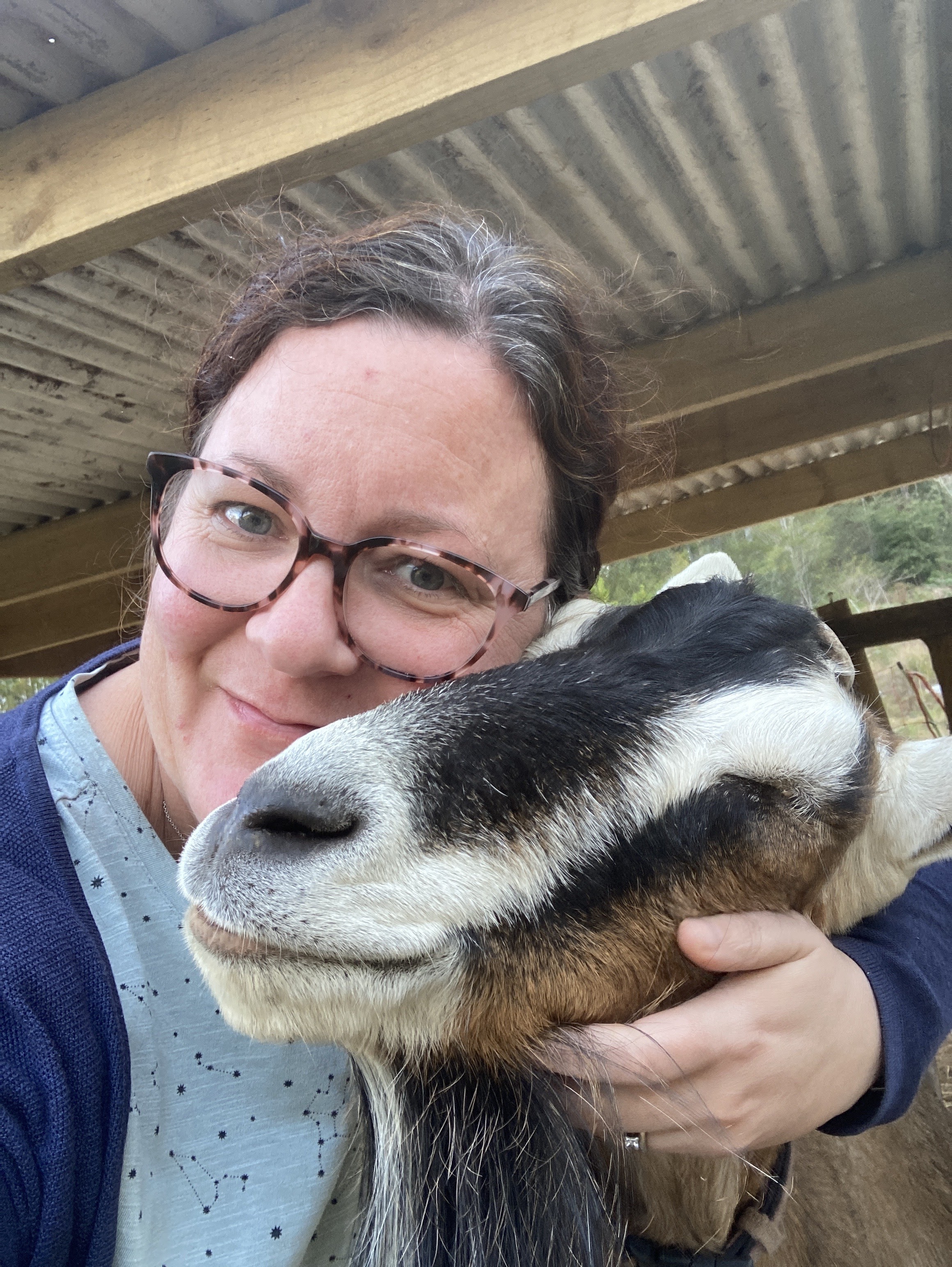
This is Hoopla our British alpine dairy goat, just popping in to say hello too. 

Back in May, I started a permaculture course with David Holmgren and Beck Lowe through Melliodora and it's been wonderful to connect with like-minded people all over Australia and the world. I'm nearing the end of it now and it has helped to clarify a priorities list and given me ways in which to talk to Grant about what is important to me. We have been tinkering with designs and working out what is of high value to us. We have been working on the yurt garden (which in a permie sense is our zone 1) over winter as it is something we could do with very little money utilizing what we have here. We have used large rocks from the farm to build garden boarders and paths, used timber logs from the forest as stepping stones and then we have been bringing in either a load of compost or gravel for the paths once a fortnight. There are still a few more loads to go, but in the meantime, we have been sowing seeds and planting seedlings in the garden spaces as they are built. We managed to find a pond and outdoor setting for free off Facebook Marketplace which has been amazing. Already there has been a huge transformation and I can't wait until it matures and fills out.  I'll be sure to share the design with you all once I have finished tinkering with it, though as gardens are always evolving, it too will no doubt change. 


One of the best things about doing the permaculture course has been the people. The teachers David and Beck are amazing, but it's been delightful being able to meet so many people on the same path. It seems like Instagram and Facebook have gotten incredibly loud with either nastiness or endless advertising of things we can't afford or are not realistic to our way of life. I miss the days when everyone was blogging and sharing their stories and pictures of their gardens cobbled together out of this and that, their projects on the go and their modest DIY housing projects. Now it seems people are either a professional interior designer or a florist! Which I know of course isn't true, it's just what the algorithms want us to see. But golly it's annoying. Rhonda Hetzel is back on her blog Down to Earth, and it was a timely reminder to share here what we have been up to. 


Turning 40, falling into a rut and my last baby suddenly seeming grown....Well, I lost myself there for a bit. We are also quite isolated on our property, primarily due to the driveway and I struggle with that. But with Grant's encouragement, I have been making a big effort to catch up with friends for coffee or dinner in town and it's brought much-needed balance to my life. I've also started attending a bible study fortnightly through our church and the people in it are wonderful. To do things just for me again after being deep in the season of mothering and our 4th baby has indeed been a blessing. 

But with spring at our doorstep, it seems like a new season is here in my life too. Having broken the back of the yurt-yard garden, I've been reminded of the potential this somewhat wild property holds. 

The next job to tackle will be to build a new chook yard, expand our flock and then we will focus all our energy on starting the deck. We have decided that aside from the odd day on 'can't be ignored' farm jobs, the undercover deck with two more bedrooms, a small bathroom and a summer kitchen needs to be our absolute priority. For the sake of everyone's sanity. The boys are getting bigger and I have resumed theological study part-time and need a quiet space to work. The yurt is a sweet little home but it is not quiet, nor spacious. 

This introvert needs a quiet nook all of her own! 


Well, I'll keep today's post short as I have things I need to get stuck into study-wise. But it's good to touch base with you all and I apologise it's been a while! But all is well in our little corner of the world, how are things with you? 

Much love,
Emma
xx


16

Why we chose to live in a yurt

Sometimes I get questions about why we live in a yurt. I wrote a post about living in a yurt before which I have linked to further down in the blog post. In that post, I talked about dimensions, shared floor plans and some of the practical aspects of living in a yurt. 

But as the cost of living is rapidly increasing with the rising interest rates and inflation I wanted to share more deeply about why we made the decision to live simply in alternative housing. I hope by sharing our story that it will help others look at where and how they are living, and if there are things they could consider doing differently during these difficult times. Not necessarily to live in a yurt, because for most people it wouldn't suit nor be even possible. But to perhaps help people see the benefits and potential of living in a smaller, more humble home. I guess I hope to provide some balance to the narrative that bigger is better. 


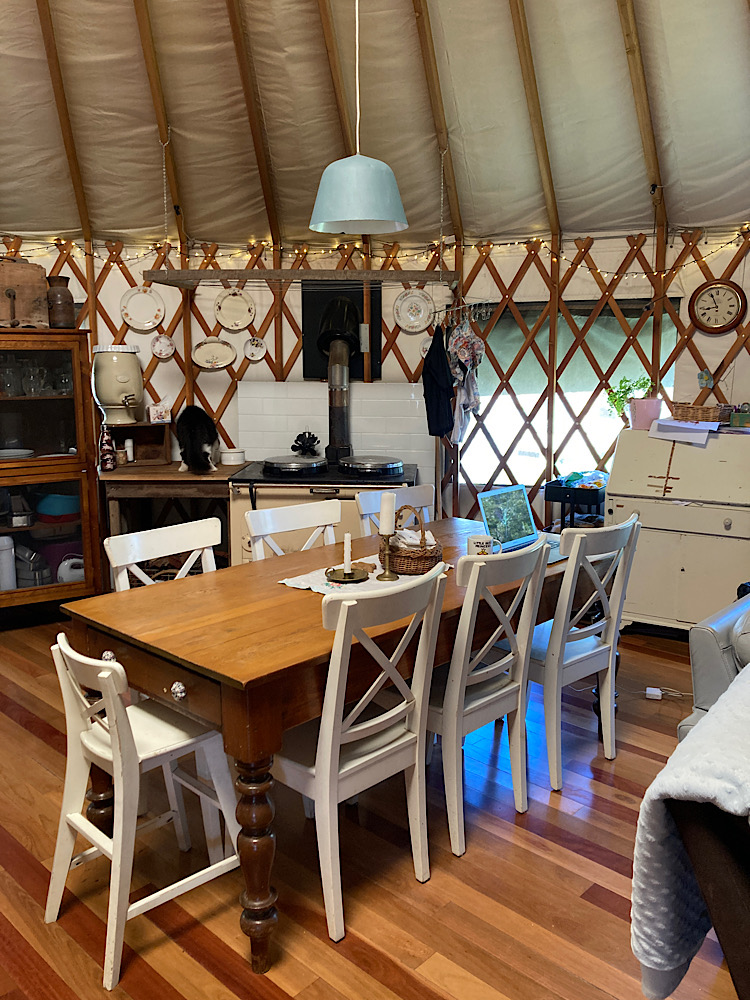
Our kitchen is small but functional. I do a lot of prep on the kitchen table too. 

Living in a yurt

Firstly living in a yurt is nothing new. People have been living well in yurts for thousands of years. Originally they were primarily used as traditional housing for nomadic people in Central Asia, particularly in Mongolia. If you're interested you can read about the history of yurts HERE.

If you want to see more you can watch this great documentary on YouTube - Life with Mongolian Nomads (Kate Humber Documentry)

Our yurt is a modern yurt, roughly based on a traditional design but using modern building methods and materials. While a modern yurt can be pulled down and moved, it is a big task and still relies on a deck or a round subfloor, whereas a traditional Mongolian yurt/ger can be erected on the ground and packed and unpacked with relative ease. We have lived in our modern yurt for 3.5 years now. I call it a modern yurt due to the materials it is built with. It is not made with wool felt and canvas like traditional Mongolian yurts or gers. Instead, it is made with a heavy-duty coated polyester material and the roof is made from fire-resistant heavy-duty industrial vinyl. It also has a thin layer of man-made insulation. There is some debate in the yurt world about these kinds of modern yurts not being "real" yurts or that man-made materials are inferior. But each to their own. For us our home and its style suits us and the region in which we live quite well.  


The tall roof adds to a feeling of spaciousness. 

Being in the sub-tropics we often have prolonged periods of rain and very high humidity. A traditional yurt made with natural fibres would not be well suited as they would struggle to dry out and would develop mould. Mongolia is a cold, dry region and the natural materials used in traditional yurts is better suited to dry climates where they can breathe easily. 

Choosing a yurt as a home filled the brief we had at the time. We needed a home that came together fast for not a whole heap of money. The yurt was set up in a week and gave our family a comparatively spacious home compared to some of the alternatives we had considered like a bus or large caravan. Once it was up, it was essentially done. We didn't have to insulate, plaster or paint while trying to live in the space, which was essential to me. Moving interstate with a young family was enough to juggle at the time. 

We have adapted our yurt over the years and put in internal walls, a kitchen, a loft, cupboards and shelving. It is no longer a movable building. When we initially built the yurt it was one big open space and we positioned wardrobes and bookshelves to give us privacy. It helped that our children were a lot younger at the time and privacy was less of an issue. The internal space of our yurt has evolved over the years and suits us quite well now. Though we will be adding a large undercover deck with an extra bedroom on it when we can, hopefully starting in a few months.   

We chose a yurt as a home as it was important to us that we lived on our property from the beginning. We couldn't afford to build. If we had chosen to live in a rental property and tried to save a deposit to get a loan to build, we would still be renting now and would have frittered away many thousands of dollars in the process. The average weekly rent for a family home here is $500-$600. That cost over 3.5 years would roughy have accumulated to $90,000 - $100,000 plus bills. Easily double what we have spent living in our own small but comfortable yurt home.  

A yurt isn't a perfect home. It is poorly insulated compared to a traditional home and it is a hot building in summer. But we have many windows we keep open in the summer months and run fans which get us through the worst of it. We can go for a dip in the creek/river to cool off and if it is unbearably hot we do have a small air conditioner that I can position a chair in front of to create a cool little play space on the floor. It isn't big enough to cool the whole yurt but it's enough. However we have to run the generator for it, so we don't use it often. There are many people who believe that living in constant climate-controlled environments is not healthy for our bodies and that experiencing varied seasonal temperatures in our bodies builds hardiness. Perhaps it is not a bad thing, it certainly means we go swimming more in our beautiful rivers and oceans. 

Our wood-burning Aga keeps us warm in winter, as does wearing jumpers and putting extra blankets on our beds. 

Yurts look complicated, are they easy to set up?


In short, yes. We found the Pacific Yurt very easy to assemble and we did it mostly by ourselves over a week. However, the roof covers are very heavy and awkward and require a couple of strong people to help get them on. We found the Pacific Yurt instructions very clear and also their customer service was excellent. I'm confident that if we had any queries or issues during the building process, they would have been more than happy to advise us of a solution.  


If you want to read more details about our yurt, its design and its floor plan you can find an older post I did HERE. 

How many years does a yurt last?

A yurt is essentially a timber-framed building and as such the frame will last as long as any other timber-framed building, as long as the covers of the yurt are in good condition. The frame will need to be kept dry to protect it and observed for signs of borers or termites over the years. You can buy replacement covers if needed, or some people clad them with solid siding once the covers wear out. I have seen many people who have been living in their yurts for 15-20 years and the original covers are still going strong. All homes need some form of maintenance, be it paint, roof repair, gutters fixed etc. Since the yurt is a small and simple design, the maintenance required is minimal. So far we have not done anything nor had any issues with the exterior. Though the outside could do with a gentle scrub with a soapy broom and a good rinse. This a job we will tackle once we have the window covers on for winter.  

The interior lattice does collect a little dust but that's not hard to deal with a handheld broom and a vacuum cleaner once or twice a year. 

Is it legal to live in a yurt?

In most places in Australia, you will not get council approval to live full-time in a yurt. However, you may get approval to have a yurt on your property and live in it a couple of days a week. So if you choose to live in a yurt or a similar kind of alternative dwelling you will likely do so at your own risk. It is important to consider the region you are in and how pedantic your local council is and if there are other people living in unapproved dwellings to see if it is generally accepted. Where we are there are people all through the mountains living in sheds, shacks, caravans and tiny homes hidden out of sight, just as we are. If you are going to live in an unapproved dwelling it is best to get along with your neighbours because the council will often turn a blind eye as long as no formal complaints arise.

Each country and state will have its own rules and regulations which you will need to research for yourself. 

Why would you choose to live in a yurt if the council can force you to move out? 

We choose that risk because we want to live well and maximise the time we have as a family together. We do not want to live our lives with both parents being forced to work just to survive. I understand for many people there is little choice and it is necessary to have two parents working full-time.  We know from our own lives it is very difficult to support a family these days if you're on a low to modest income, many single parents face even more challenges. Many other people love their careers and find their paid work valuable and enjoyable and want to balance that with an equally meaningful home life. 

We are all different and I think that is a very good thing. 

For us living in a yurt minimised debit, which allowed us to afford to have one parent at home. This is a decision we value as a family and will continue to do for as long as it's viable and suits us. We want to live a simple home-based life and to spend as much time as a family together as possible. We don't want to put our kids in childcare/before-school care/after-school care if we can avoid it. Given the distance, our children have to go to school that would not only be very tiring for them but it's expensive too for a family our size. We want to have the time to milk goats, build our farm, garden, cook nourishing meals and be present for our children. To make that possible we make choices that enable us to live as cheaply as we can and minimise debt. 

Here you can see the stairs leading up into the loft. Under the stairs is a big pantry. 

It seems that with each generation the average person is losing essential skills that would have once been considered normal. Many people can't sew on a button or take up a hem. They don't know how to mend, cook, ferment, fix or build things. We have an epidemic of depression, loneliness and isolation. Our children are at risk of being the first generation to live shorter lives than those before it due to the increasing presence of chronic health problems. This detachment from the basic elements of life seems to be the opposite of "progress" in all the areas that truly matter. 

Not so long ago in Australia, an average family could buy a block of land in the country and build a simple, modest home themselves for their family using local materials. Now it seems there are endless boxes to tick, forms to fill out and criteria to meet. I think in many cases the endless red tape to get through has gone way above and beyond what is sensible and logical. Not to mention there is a fee to pay at every turn which is clearly fattening someone's pocket.  When I look at housing developments today I see big homes with multiple living spaces and bathrooms that take up the majority of their small blocks. There is little room left for children to play outside, for dogs to run or to create beautiful, productive gardens. The homes are designed so individuals all have their 'own space' which on one hand can be nice, but in a small home, people are naturally brought together. They learn how to adapt to each other and their needs out of necessity and practice. Generally speaking, the majority of people have lived in small homes throughout the ages, and there is an element of living small that is deeply beneficial to fostering close relationships.  

This is the boys loft, The room is divided in two so they each have their own space and their own set of custom shelving that utilises the height in the ceiling. 

For us living in a yurt is a way we have chosen to live a little outside the system, a way we can claim back some of our independence from debit and financial pressure whilst still having a sweet and cosy home for our family. We can't escape rates and taxes, and we are happy for our dollar bucks to go towards important services that help the collective good. But what we can do is choose to minimise our personal debt in every way possible and live a life that aligns with our values. 

Will we always live in a yurt? I don't know. There are parts of a traditional home that I miss, but then I suspect if I were ever to move back into a traditional home, there would be parts of living in a yurt I would miss also. 

For us during this season of life, it works. 

Much love,
Emma
xx

3
Powered by Blogger.